Tag: dirtbag

  • Seven Spanish Angels: How I learned to project (boulders)

    Seven Spanish Angels: How I learned to project (boulders)

    When I started trying Seven Spanish Angels, it was my first season of outdoor bouldering. And I was starting off in the “big leagues” by picking an ultra classic highball destination like the Buttermilks.

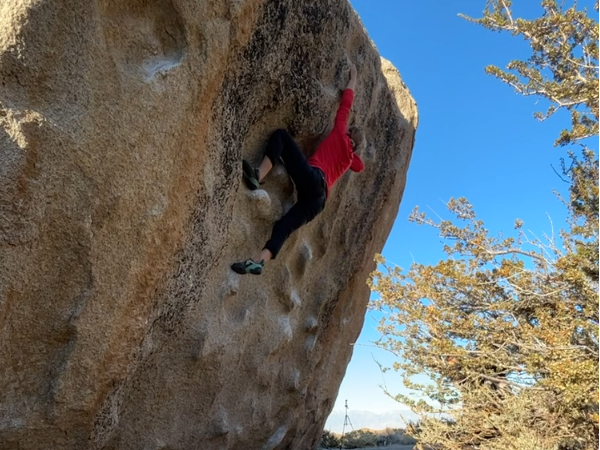
    I sent my first v4 across town in the Happies: Solarium, which was pictured on the front of the local Bishop bouldering guidebook. And I figured the best thing I could do was to begin projecting the boulder feature don the back cover – a v6 called Seven Spanish Angels.

    boulder
    The inspo. Very simple.

    The first time I pulled up to the boulder I was impressed by the lean. It seemed to tip out over me more than any online beta video or image could convey. I was intimidated. But I still wanted to try.

    Starting out – Expectations

    I had no clue how to approach a bouldering goal at (or above) my limit outdoors. But there is something psychologically easier about projecting a “harder” boulder. I can let go of expectations – something that usually haunts me.

    Normally if I expect to do a boulder, I find it hard to turn on that “high gear” and put in 100% effort. At the time, I was still learning to tolerate the discomfort of 100% effort, with no guarantees of success. But if I pull on in the psychological state of assuming I am not going to top it, then I can allow max effort and flow. No expectations.

    Projecting lesson: Be open minded to learn something new about the positions every time I pull on. Expect to learn something, rather than to top it. Anything to keep my mind focused on the moves to the top, rather than the top itself.

    Lately my boulder “project” has been learning to recreate that no-expectations state when a boulder is in the I’m-expecting-to-send range.

    Research – Beta

    The first day I pulled on, I had already watched a bunch of beta videos to see how other people did it. But it didn’t matter at all (yet) because I couldn’t even get past the first move or two. And there was no way to pull on in the middle (not that I knew to do that).

    Later, watching other climbers IRL or via beta videos, I realized there were a couple of main methods, and I selected the one that looked “coolest”, rather than the one that suited my body…. and I refused to try the static method… for WAY too long.

    Projecting lesson: Watch beta videos… and try all the different betas, including my own! Don’t just pick what looks cool.

    Getting ready – Working out the moves

    I returned to the boulder repeatedly, and made a little progress each time, which was inspiring for me. But it was also frustrating… how much more micro progress could I make before I’d finally be able to send?!

    I was still hyper focused on the top.

    I finally tried some different beta that was helping me make faster progress.

    Visualizing – Tolerating Discomfort

    Once I had enough sessions that I was starting to hold positions on the boulder I realized how uncomfortable the positions were, and how scary it was to move between them when it was precarious.

    I started visualizing. I’d see and feel myself on the boulder, topping out. It didn’t work. So eventually I started realizing that the discomfort made the gap between sending and stagnating untenable.

    Projecting lesson: Visualize how the moves feel, and moving through positions that may not feel comfortable. Practice moves in my head WITH the breaths I’ll take while climbing. Believe it’s possible for me. Don’t just imagine topping it.

    I addressed that by imagining how uncomfortable I would feel in each of the positions and then seeing and feeling myself continue moving even when I was uncomfortable. I imagined it daily for almost a year.

    Mental game – the crew

    The project lasted forever, in part due to picking something inappropriately difficult, and in part due to a snow season that ruined the road and kept me away for 49 weeks. That was torture.

    There was a “crew” element that I cannot downplay. Every time I made progress with a new high point, there was a crew working the boulder with me.

    Whether it was with people I knew or just met, having folks around working on the same thing was immensely helpful.

    Projecting lesson: Embrace a crew that cheers when the going gets tough. Trade beta, and encourage each other.

    At some point, I felt mentally “ready” to do the moves. But it was still hard for me, so I needed things to align.

    Sending – not the end

    When I finally sent SSA, I felt a huge wave of relief. That’s because I had been fully obsessed… and that’s because I had a one track mind, felt I was “close”, and was blocked from continued efforts by snow storm after snow storm in the ’22-’23 season.

    I was so so glad to have had the experience but also just glad it was over. I learned that it’s best to project multiple things at once, and not to put all my sessions into simply trying the proj. Some volume days and fun social sessions needed to be mixed in.

    Projecting lesson: Date multiple boulders at a time. Enjoy and relish the process rather than obsessing. Mix in non-projecting sessions where I don’t even get on the thing.

    I learned a lot from SSA. And after sending a boulder for the first time, it might still have something to teach me. I can come back and find something different each time I try a boulder. It’s about the journey, rather than the destination. I try to take that to heart now when I’m projecting boulders.
  • Entering my #vanlife era

    Entering my #vanlife era

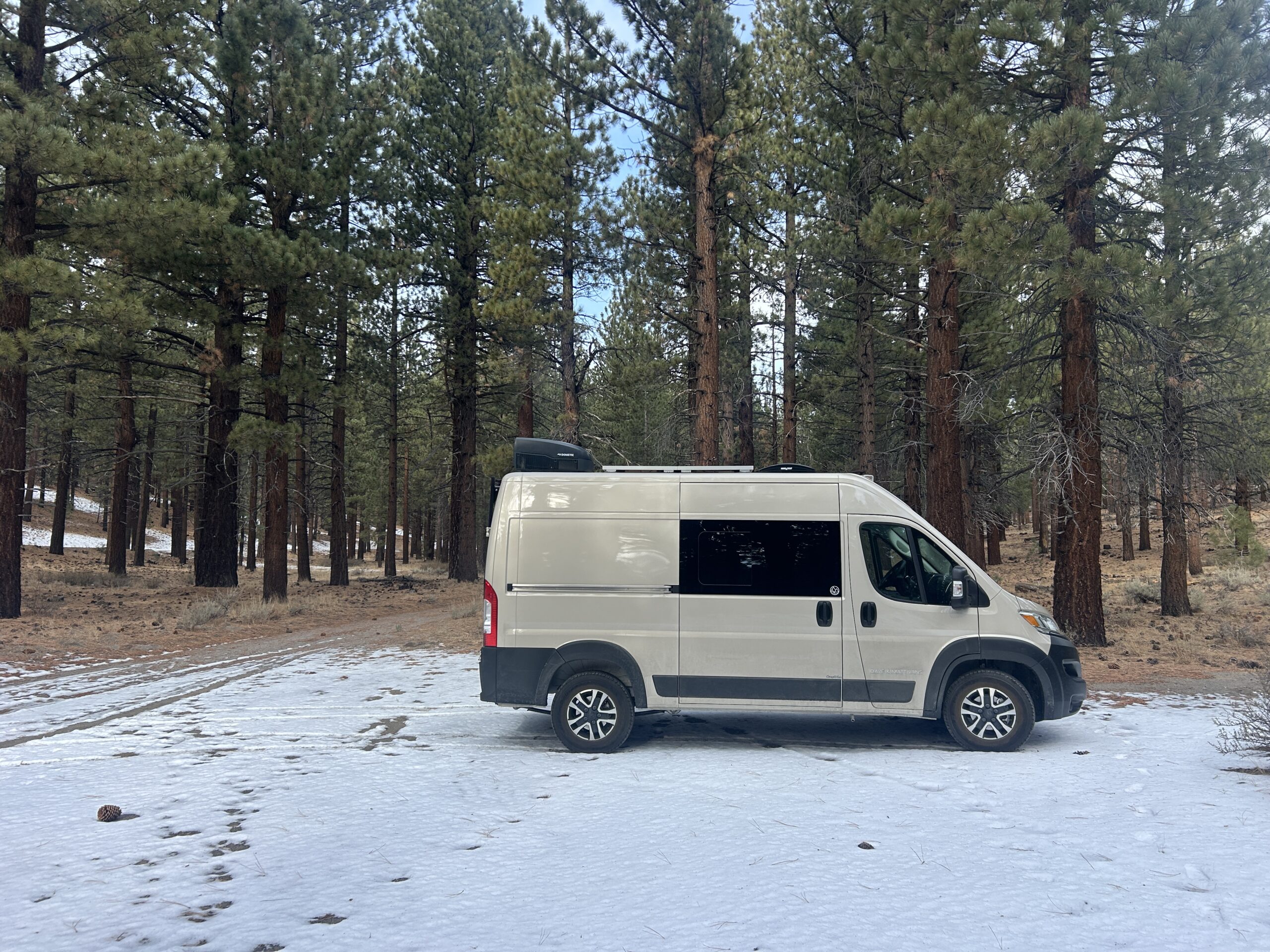
    It’s official… I’m a #vanlifer now. My time as a “real” dirtbag is done! After a year and a half living out of my CRV full time, I’m in a nice van now.

    It’s super comfy by comparison, and I still most of the benefits of being a car-lifer, such as living in deeper connection with nature, a sleep schedule attuned to the sun, and a life organized around getting outdoors. Some things are different, like for example it’s more difficult to parallel park, and gas is more expensive, but I wouldn’t go back because the benefits outweigh the drawbacks for me.

    In October, the temps at night started to drop and I was not excited about another winter of “roughing it” in sub-freezing temps without a proper heater.

    I really wanted to be able to take better care of myself and have more energy for things besides just existing. I felt I had earned my stripes and it was time for an upgrade, so I started actually figuring out how to acquire a van.

    There are two main options when you’re considering van life, and my friends all had opinions. The options are 1) DIY or 2) buy. Within the buy option, you can buy new or used, get one made bespoke, or buy one off the shelf.

    It was going to be a trade up no matter what because the CRV life is so basic. My main wish list features for my van were: 1) heat, 2) being able to cook indoors when weather is bad, 3) being able to work and take private calls from my own space.

    I did consider a DIY build first, because my bar was pretty low and i have many friends who thought I’d be able to do it no problem. But a big driver for getting a van was giving the ol’ nervous system a break finally… and trying to learn to build a van sounded stressful. After a bit of stress spiraling trying to decide whether to DIY or buy, I made up some math (versus renting) to justify an already built out van purchase.

    I started looking for builders. And there are so, so many van builders. For me two big things drove the selection.

    First, I was starting to freeze my forehead off in the cold nights, so this was urgent and that pushed me to search for off the shelf, rather than bespoke options. Most van builders had 3 month or longer wait times for custom builds, so it was off the table for me.

    A second factor that narrowed conversion companies was that I wanted a brand new chassis for my off the shelf van. I don’t know how to evaluate a used car and it felt overwhelming. Again, a major goal was to relax a bit more and take care of myself… overwhelm was not a good option for me. So, I browsed companies that had new van builds off the shelf.

    I was lucky to have found Dave & Matt vans, based out of Rifle, CO. They do quite a bit of volume, and were super helpful throughout the process. They’re used to climber builds, and had everything I needed.

    The only thing I really wish I had is AWD for snowy days, but that’s for a future build. I could remove the AC and still be quite happy. I tend to go up to higher altitudes when it’s hot anyway.

    Life has a funny way of teaching us things working itself out. I got interested in #vanlife back in 2018 and it was so far from anything I knew personally that it was hard to imagine actually pulling the trigger. I was still trying to fit myself into the box of expectations handed to me by society.

    Despite the distance from my personal circumstances back in 2018, I somehow knew van life was for me, even then, from my comfy studio apartment in downtown DC. It turned out my self knowledge was accurate, I just didn’t have the gall to trust my gut and jump off that particular cliff back then. But I do now, and it turns out that van life suits me after all.

  • Dirtbagging. Living the cozy #crvlife

    Dirtbagging. Living the cozy #crvlife

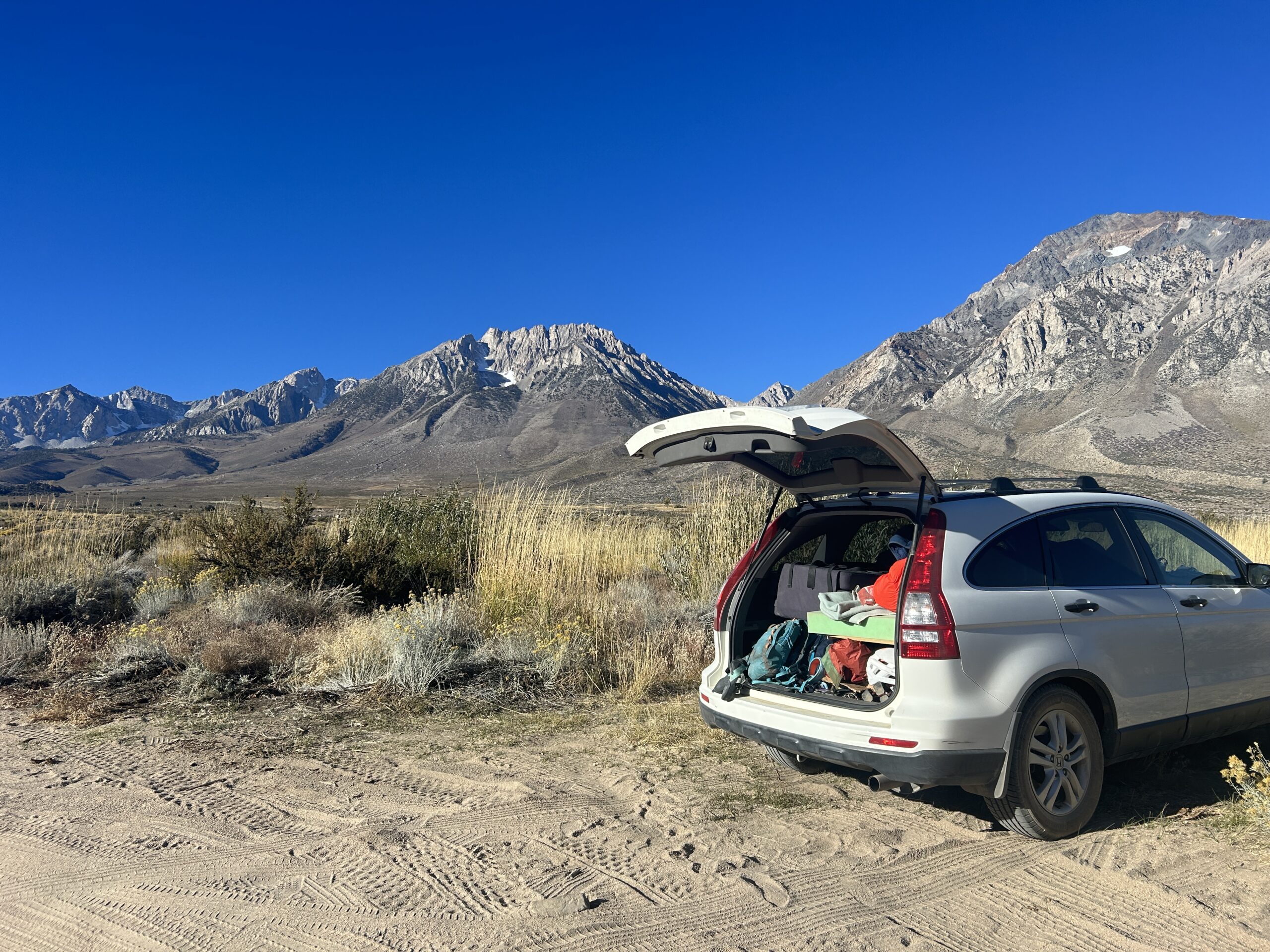
    car with mountains

    For the better part of the past 1 year, I’ve been living in my 2011 Honda CRV. I’m a climbing dirtbag. At the start of my dirtbag era, I kept my apartment, because I thought this era would quickly end. But I have quickly made it a comfortable lifestyle. After not visiting the apartment for months at a time, I decided to get rid of the home base all together and opt for a PO Box instead. The car is pretty cozy, and when I did visit the apartment I suffered from terrible insomnia. In retrospect, the choice was obvious, but there was lots of turmoil involved in making the decision, which I addressed in a post on TinyBuddha. Here, I’m focusing on how I managed to get so cozy living the #crvlife.

    Building out the CRV:

    1. Remove Seats: This era of CRV has back seats that do not fold flat. I took out the passenger side and attached middle seat to have space for my bed platform. Initially I left them in, but its much better without them in terms of storage and stability.
      • It’s pretty straightforward to remove the seats once you pop off the plastic bolt covers. There are 4 bolts and you need a socket wrench to undo them. The seats are quite heavy also. I saved the bolts and used them to attach my sleeping platform.
    2. Sleeping setup: This is basically the only “build” I actually did. I sleep with my head toward the front of the car and prop the passenger seat forward when I sleep so I can dangle my feet.
      • Materials:
        • sheet of plywood – standard size, composite because it’s less splintery
        • 4×4 – 12′
        • 1×1 – 12′
        • package of screws & corresponding bit
        • drill
        • L shaped metal brackets
        • straight metal brackets
        • wood glue
        • the bolts I unscrewed
        • socket wrench
      • Platform: I had home depot cut my plywood to size. For me that was 70″ long and 26″ wide. When I got it home, I cut a diagonal corner for the back passenger side of the platform, so it could be propped up on the lip of the wheel well (this is one “leg” of the bed).
      • Framing: For sturdiness, I added two strips of 1×1 framing along each long side of the bed platform. I attached it with screws and wood glue.
      • Front Legs: The front “legs” were made from one solid block of wood. I used 24″ cuts of my 4×4 and stacked them on top of one another, attaching them together with straight metal brackets and wood glue to one another. Then I attached them to the car with the L brackets, straight brackets, and bolts from the seat removal. This block of wood is not at the end of the plywood, it’s around a foot or so in from the edge, and supports the shoulder area of the sleeping platform. I attached the platform to the front “legs” with L brackets and screws. and attaches to the 1×1 framing with L brackets.
      • Back Legs: The back “legs” are each done pretty differently. The outside edge rests on top of the car itself. For me, that provided the most snug fit, and most space underneath the platform for storage. For the other back leg, I used the remainder of the 4×4 piece, it’s just under 12″. I attached it to the framing using L brackets. It’s very sturdy and falls around mid-calf, rather than at the very back of the platform. That allows me access to the things under it more conveniently.
      • Comfiness: I use a 6′ piece of 4″ upholstery foam from JoAnn fabric as my mattress. I put a sleeping pad on top of that for warmth. Then I use a 0 F sleeping bag and a wool blanket on top of that in winter.
    3. Electricity & warmth: I use a Jackery and a heating pad when it gets below 30 F. I just use a small battery to charge my phone at night and I get about 2 nights off a charge. I have a solar lantern for when it gets dark and I want to read. But typically I sleep when the sun says it’s time.
    4. Curtains: I don’t use them! I can cover a window or two if needed with a towel, but I normally camp in rural places rather than in town. Plus, without curtains you can see the stars better 🙂
    5. Storage: A roof rack is in my future. But for now it all fits inside. Food in the driver’s side back footwell. Crash pad next to bed, clothing in bags under that. Climbing & camping gear under the bed. Toiletries, coats, water and electronics under the passenger back footwell. And miscellaneous in front seat.
    parked somewhere good

    Living on the Road:

    Budgeting and Finance:

    1. Frugal Living: I keep expenses low. Most of my costs are health insurance and food. Climbing is free.
    2. Food: I use the Eureka Spark single burner camp stove and I cook a lot of simple, repetitive things. Protein bread + avo + egg = chef’s kiss. One pro of living in your car in winter is that you don’t need to buy ice or anything if it’s cold out and food stays good for a long time.
    3. Passes and Permits: I normally sleep on BLM land, which I find via Gaia, but I also have a national parks pass.

    Hygiene and Comfort:

    laundry
    1. Shower Solutions: It depends on location
      • I belong to Planet Fitness, which works great in bigger cities. Plus you can sleep in the parking lot if needed.
      • Hostels and gas stations often have showers for a fee, which is convenient.
      • An occassional hotel night comes in handy to recharge, refill, and shower all at once.
      • In between showers, I jump in lakes/rivers.
      • If I’m not showering that day, I wipe down sweaty areas with antibacterial wipes (not baby wipes). Antibacterial wipes keep bacteria levels down on the skin, which is what causes BO.
    2. Laundry: Laundromats can be a great place to get wifi and stay warm if it’s chilly on a winter evening.

    Safety and Security:

    1. Knowledge: I try to stay in places I know and if I’m going somewhere new I arrive in daylight and camp with friends if possible. I always give myself permission to leave an area at any point and I try to have a backup plan if I’m sleeping somewhere I’ve never been.
    2. Vehicle Maintenance: I get regular car checkups. That said, I’ve popped a couple tires on dirt roads at this point, so it helps to be prepared. I check to make sure my spare is inflated, plus I’m a AAA member, and I have a portable air pump and some patching spray for temporary fixes.
    3. Security: I don’t keep valuables in my car, but I do always lock my car and keep things out of sight.

    So far, the #crvlife has been good to me. It’s hard to believe a year passed this quickly. It has made me realize how little I really need to feel at home and happy.