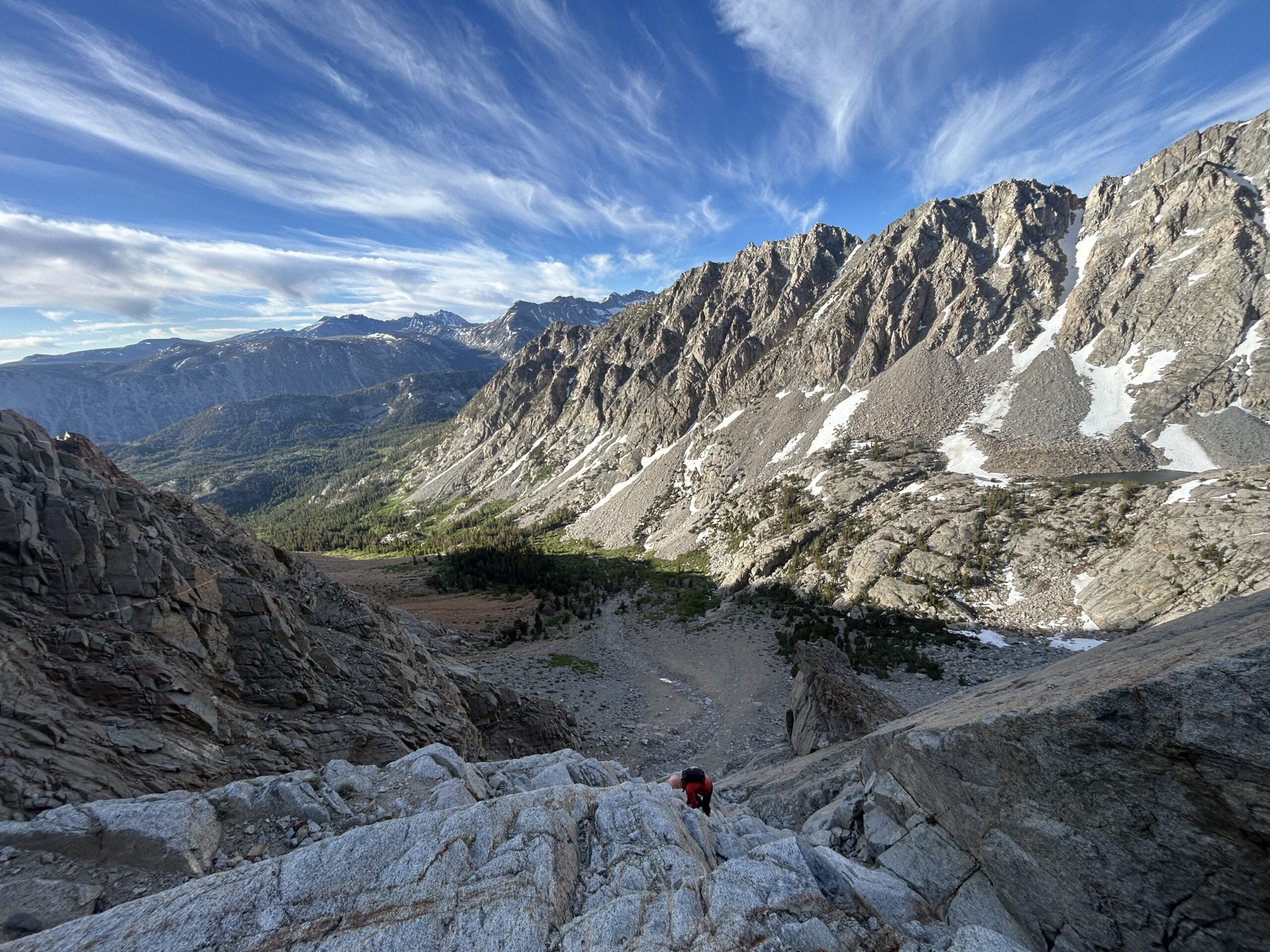
Tag: sierranevada

  • Seven Spanish Angels: How I learned to project (boulders)

    Seven Spanish Angels: How I learned to project (boulders)

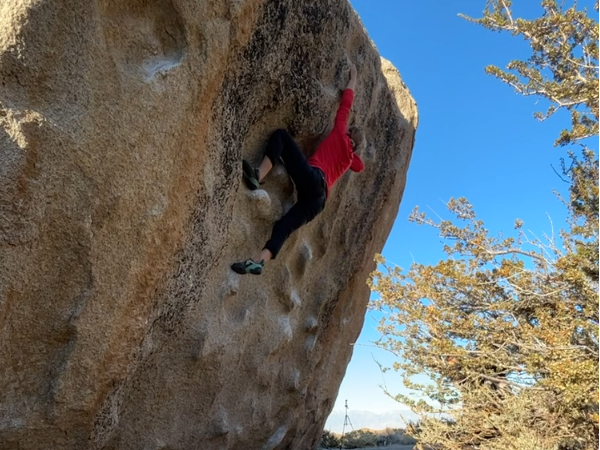
    When I started trying Seven Spanish Angels, it was my first season of outdoor bouldering. And I was starting off in the “big leagues” by picking an ultra classic highball destination like the Buttermilks.

    I sent my first v4 across town in the Happies: Solarium, which was pictured on the front of the local Bishop bouldering guidebook. And I figured the best thing I could do was to begin projecting the boulder feature don the back cover – a v6 called Seven Spanish Angels.

    boulder
    The inspo. Very simple.

    The first time I pulled up to the boulder I was impressed by the lean. It seemed to tip out over me more than any online beta video or image could convey. I was intimidated. But I still wanted to try.

    Starting out – Expectations

    I had no clue how to approach a bouldering goal at (or above) my limit outdoors. But there is something psychologically easier about projecting a “harder” boulder. I can let go of expectations – something that usually haunts me.

    Normally if I expect to do a boulder, I find it hard to turn on that “high gear” and put in 100% effort. At the time, I was still learning to tolerate the discomfort of 100% effort, with no guarantees of success. But if I pull on in the psychological state of assuming I am not going to top it, then I can allow max effort and flow. No expectations.

    Projecting lesson: Be open minded to learn something new about the positions every time I pull on. Expect to learn something, rather than to top it. Anything to keep my mind focused on the moves to the top, rather than the top itself.

    Lately my boulder “project” has been learning to recreate that no-expectations state when a boulder is in the I’m-expecting-to-send range.

    Research – Beta

    The first day I pulled on, I had already watched a bunch of beta videos to see how other people did it. But it didn’t matter at all (yet) because I couldn’t even get past the first move or two. And there was no way to pull on in the middle (not that I knew to do that).

    Later, watching other climbers IRL or via beta videos, I realized there were a couple of main methods, and I selected the one that looked “coolest”, rather than the one that suited my body…. and I refused to try the static method… for WAY too long.

    Projecting lesson: Watch beta videos… and try all the different betas, including my own! Don’t just pick what looks cool.

    Getting ready – Working out the moves

    I returned to the boulder repeatedly, and made a little progress each time, which was inspiring for me. But it was also frustrating… how much more micro progress could I make before I’d finally be able to send?!

    I was still hyper focused on the top.

    I finally tried some different beta that was helping me make faster progress.

    Visualizing – Tolerating Discomfort

    Once I had enough sessions that I was starting to hold positions on the boulder I realized how uncomfortable the positions were, and how scary it was to move between them when it was precarious.

    I started visualizing. I’d see and feel myself on the boulder, topping out. It didn’t work. So eventually I started realizing that the discomfort made the gap between sending and stagnating untenable.

    Projecting lesson: Visualize how the moves feel, and moving through positions that may not feel comfortable. Practice moves in my head WITH the breaths I’ll take while climbing. Believe it’s possible for me. Don’t just imagine topping it.

    I addressed that by imagining how uncomfortable I would feel in each of the positions and then seeing and feeling myself continue moving even when I was uncomfortable. I imagined it daily for almost a year.

    Mental game – the crew

    The project lasted forever, in part due to picking something inappropriately difficult, and in part due to a snow season that ruined the road and kept me away for 49 weeks. That was torture.

    There was a “crew” element that I cannot downplay. Every time I made progress with a new high point, there was a crew working the boulder with me.

    Whether it was with people I knew or just met, having folks around working on the same thing was immensely helpful.

    Projecting lesson: Embrace a crew that cheers when the going gets tough. Trade beta, and encourage each other.

    At some point, I felt mentally “ready” to do the moves. But it was still hard for me, so I needed things to align.

    Sending – not the end

    When I finally sent SSA, I felt a huge wave of relief. That’s because I had been fully obsessed… and that’s because I had a one track mind, felt I was “close”, and was blocked from continued efforts by snow storm after snow storm in the ’22-’23 season.

    I was so so glad to have had the experience but also just glad it was over. I learned that it’s best to project multiple things at once, and not to put all my sessions into simply trying the proj. Some volume days and fun social sessions needed to be mixed in.

    Projecting lesson: Date multiple boulders at a time. Enjoy and relish the process rather than obsessing. Mix in non-projecting sessions where I don’t even get on the thing.

    I learned a lot from SSA. And after sending a boulder for the first time, it might still have something to teach me. I can come back and find something different each time I try a boulder. It’s about the journey, rather than the destination. I try to take that to heart now when I’m projecting boulders.
  • The most aesthetic choss factory: Temple Crag

    The most aesthetic choss factory: Temple Crag

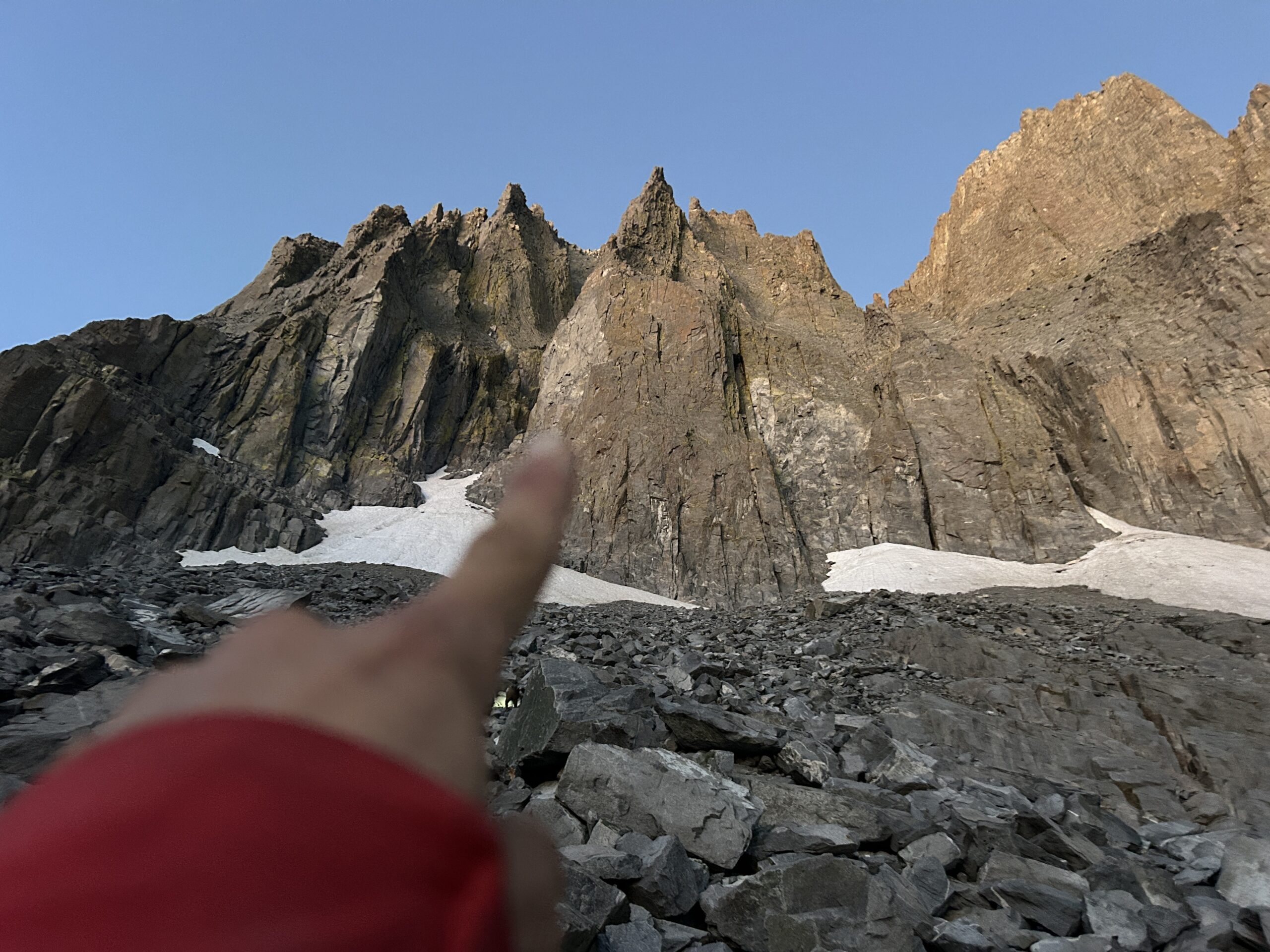
    In August, my friend got permits for Temple crag in the Sierras and we decided to go for Sun Ribbon Arete. Before heading up there, I thought I’d want to come back for Dark Star… but honestly, it sounded quite loose and I think I’m good for now.

    I had just been dumped, and my mindset was shambolic. But I figured crying outside with friends was better than alone in the van, so I soldiered on. Don’t worry I told my climbing partner beforehand and he graciously gave me the crux… I guess it felt better having a “real” reason to cry.

    temple crag

    The route appealed to my partner and I, not just for the aesthetic nature of the line, but also because it has a natural tyrolean traverse.

    Third lake camping

    The hike in was really nice, and there was water along the way for a lot of it. That was great because I really didn’t want to carry more extra weight.

    hike

    After a little nudie dip to rinse off from the hike, we set up camp by third lake. I’d say that or second lake would be good places to camp. First lake would be a little extra commuting.

    The route finding

    We got started around 5am to give ourselves plenty of daylight, and were at the base of the route a little after sunrise. I am glad we started early becuase once we were on route I felt like we were moving slowly.

    There were a couple of pitches with good crack climbing, but they were interspersed with crumbly scrambling, wandering pitches. It was still worth doing though. I took odds and we linked whatever we could. I do tend to lose track, but I figure we did it in around 16 pitches.

    The route finding wasn’t as easy as I was expecting with it being an arete. I think that’s because the topos I found online were nearly useless on pitch lengths.

    Both topos I downloaded were different and both sucked. Normally the more detailed a topo is, the more accurate I assume it is. But these must’ve been written from memory decades later. But I’m not going back to rewrite them now that I did the route – so I guess I don’t blame them.

    Part of the adventure when I go alpine climbing is the route finding, and it was fun figuring it all out.

    The tyrolean

    tyrolean traverse

    It is always hard for me to tell altitude nausea from anxiety nausea. That day on Sun Ribbon was no different.

    I was nervous for the tyrolean because I had never done one before. And I like to have something to cling to…! But it turned out completely fine. My partner lassoed the horn after a few attempts and rigged it up. We ended up belaying each other across as well because crossing air (with no rock to cling onto) is spooky as hell.

    Looking back, I did a better job eating enough when I was getting tired. Plus I had forced down most of a dehydrated breakfast meal that morning.

    My headspace for the send

    I had just gotten dumped, but when we got to the base of the 10a pitch, it was my turn to lead. And instead of yeeting myself off the cliff because I was sad, I decided that the crux was a good distraction.

    We went for the right variation and it had about 4 feet of actual rock climbing before easing up considerably. The shitty topo was accurate here in that it indicated 2 pitons close together at the start of the pitch. They were VERY (pointlessly) close, maybe less than 3 feet apart. The crux was very reasonable.

    Some characters at the top

    summit

    That day, there were parties on several routes. Sun Ribbon is right in the middle of everything, so we could look across either way and hear rockfall.

    Our good friends were on Venusian Blind, a guided party was on Moon Goddess, and another party was on Dark Star. Most of the rockfall came from Dark Star and it was comically (terrifyingly) chaotic.

    We heard so much rockfall that it felt like we were getting shot at. During the entire route, we pulled off ONE small rock. From the sound of it, Sun Ribbon must be the least chossy. Or maybe things just echo because Sun Ribbon is in the middle of everything else.

    We listened to the Dark Star party having conflicts throughout the day and when we reached the top, we met that party. One of the guys was bragging that he had now done all the routes at Temple, and explaining to us where Mt. Sill was (he was, in fact, not pointing at Mt. Sill).

    He was mansplaining to both me and my partner (a man), so I can’t chalk this one up to being a woman in the backcountry.

    Going down

    I am glad we had daylight for our descent. After the topout, we hiked down following cairns easily. Then we did the rappel, and hiked down the pass. Towards the bottom, as we got near the main trail, we ended up veering a bit left in the hallway (towards third lake) when we should’ve gone a bit right (towards second).

    It was one of the more sketchy things I’ve ever done and looking back I would revise my decision making. I would have retreated to find a better way. Lots of big blocks were breaking loose upon weighting them…. and I did end up losing a #1 doing some questionable glissading. I lived and learned, gratefully. And luckily we still had daylight.

    Our Venusian Blind friends were descending after nightfall, and they started radioing us for beta consistently because of how cryptic the descent was without light.

    They kept waking me up, but there wasn’t much we could tell them since we didn’t have their location. My partner’s Rocky Talkie died conveniently when our friends started relying heavily on radioing us for beta LOL.

    “Keep the big boulder to your right” doesn’t really help that much when I have no clue which big boulder they’re looking at.

    It reminded me of the importance of having a Gaia map downloaded at the very least. And a bivy sack. There was some concern they might get benighted… and what a terrible place that would’ve been to hunker down (rockfall hazard). But they made it back around midnight.

    Overall we spent ~15 hours camp to camp. That’s including a nice lunch lounge on route, some summit selfies, and a couple other leisurely rests at scenic spots.

    The nice thing is that we had great views of the lakes and mountains the whole time. And there were some legendary ledges to chill on 🙂 A good time with my homie.

  • Mt. Emerson

    Mt. Emerson

    “The civility of no race can be perfect whilst another race is degraded.” -Ralph Waldo Emerson

    Mt. Emerson is a peak on the Bishop skyline that sat on my to-do list for a while. I guess I didn’t have a partner. Or maybe I was intimidated by being in the backcountry alone. But earlier this year, a Montana-based friend made a climbing partner intro that helped me catch some stoke.

    The Southeast Face (aka the Waterfall route) is a 5.4 scramble and local classic and I was pretty unsure how long it would take. The car to car times in various trip reports ranged from a 1-2 hour trail run to overnight epics. I was pretty confident this would be less than a full day for us, but the mountain project page was evidently designed to reduce the number of SAR trips required.

    Totally valid, but it made it harder to calibrate. I gave us anywhere between 5 hours and 10 hours for a leisurely jaunt. It ended up taking 7, with a half hour detour for water and two long snack breaks.

    The way there

    A scenic view showcasing a snow-covered mountainous landscape with a stream flowing through rocky terrain, surrounded by patches of snow and evergreen trees in the Eastern Sierra Nevada Mountains. Watering hole near Mt. Emerson and Loch Leven outside of Bishop, CA.
    it seemed a little hard to access the water at first, but we found a gap between the snow and rock where we could access it

    We brought helmets and approach shoes. And we brought water filters. We ended up passing the last stream crossing before the cutoff without realizing it. That meant that we had to go out of our way an extra 30-40 minutes to get water. It added to our day, but the place we got water was pretty nice.

    We got to the North Lake parking lot around 5am, and started hiking just as the sun was coming up. It’s a short approach through the forest, with a few creek crossings, up to the more rocky climber’s trail. The approach trail was pretty, and I had done it before on a hike up to Loch Leven.

    At some point, the route becomes visible and we exited the trail to go cross country. Lots of gpx coordinate links are available online, but I did not record ours. The base of the climb was an obvious crack. And I regularly complain when a guidebook refers to something as “obvious”, so this was really very clear.

    A climber ascending a rocky chimney on a mountain, showcasing challenging granite formations and rugged terrain near Bishop, CA.
    first pitch, obvious crack

    We hiked up to the base and the start was probably the “crux”. It had maybe a maximum of two 5.4 moves within the first few “pitches”. The route finding was pretty straightforward by Sierra alpine standards. It was mid-June, and we encountered only one snow field in the route (at least I think it was on the route). We were easily able to dodge it by gaining the ridgeline via an earlier than normal point (I think), which was chossy.

    The climbing was cardio for me, especially as we climbed to higher and higher altitudes. But the moves were all very reasonable and maybe one move was exposed. I definitely wouldn’t want to pitch this out for any reason. If I were bringing rope, I’d bring like a few pieces (nuts?) and the shortest rope I own.

    A climber standing on a ridge line near the summit with panoramic views of snow-capped mountains and clear blue skies in the Eastern Sierra Nevada Mountains outside of Bishop, CA.
    getting close to the summit

    Halfway (summit)

    A climber sitting on a rock summit  (Mt. Emerson) against a backdrop of blue sky and clouds, wearing a helmet and sunglasses in the Eastern Sierra Nevada Mountains.
    me on the summit block, (photo creds Nate)

    The summit was beautiful and offered clear views of so many peaks, including Mt. Humphreys, Checkered Demon, Mt. Darwin, and more. I ticked this climb with more additions to the to-do list, rather than less…. classic.

    Scenic view from the summit of Mt. Emerson, featuring rocky mountain ridges, patches of snow, and a bright blue sky with wispy clouds in the Eastern Sierra Nevada Mountains.
    the view of Checkered Demon and Mt. Humphreys from the summit of Mt. Emerson

    At the top we ate lunch and had a little wind. The coolest climbing is up high, gaining the summit block. There are airy, but easy, moves on very solid granite. The views of Paiute Crags are trippy, with their marbleized coloring… it reminded me of cinnamon bread or tie dye or something.

    A panoramic view from Mt. Emerson, showcasing the rugged Paiute Crags under a clear blue sky in the Eastern Sierra Nevada Mountains.
    delicious pastry looking Paiute Crags

    The plants up there were pretty interesting too… I found myself stopping to take pics (and not just because I was out of breath LOL). Maybe I’m easily entertained, but my own backyard never fails to impress me.

    The way back

    We found the descent pretty straightforward, despite trip reports indicating that it was not. Very ledgy, and lots of loose skree.

    A person in a red jacket walking across a snow-covered slope in a mountainous terrain with rocky hills and sparse vegetation under a clear blue sky in the Eastern Sierra Nevada Mountains. She is clearly not glissading yet.
    getting ready to glissade. (photo creds Nate)

    We bounced our way down until we hit a snow patch. We didn’t bring any ice axes, but decided to glissade anyway (with rocks). Maybe not my best decision, but it was fine and much quicker than walking down the loose stuff.

    I was pretty happy to hit solid ground on the trail. We got eyes on Loch Leven, where folks were fishing, and decided to stop for snacks and water.

    The serene Loch Leven lake surrounded by rocky mountains and slopes covered in snow, with a clear blue sky and wispy clouds above in the Eastern Sierra Nevada Mountains.
    back to Loch Leven

    It occurred to me later that we summited Mt. Emerson on the same day as the politically active nationwide were demonstrating against the ICE kidnappings.

    The peak is named for Ralph Waldo Emerson, who has his own controversy, but who famously said “The civility of no race can be perfect whilst another race is degraded.” and I thought that was appropriate for the day.